Sustainability isn’t a solo fix

It’s a long game.

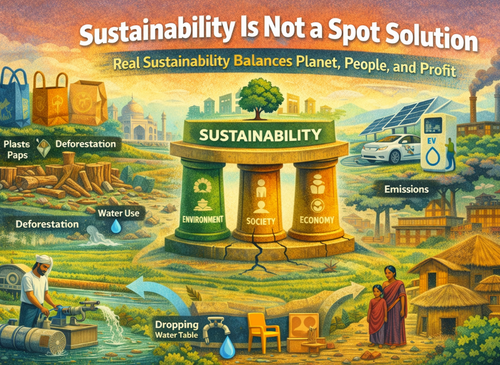
Real sustainability needs connected thinking. Environmental, social, and economic factors must work together. Solving one problem in isolation often creates another.

Spot solutions look good on the surface—but fail underneath.

Banning plastic bags sounds sustainable. Pushing electric vehicles feels progressive. But when actions focus on one metric and ignore the rest, the impact backfires.

Replace plastic with paper without checking deforestation, water use, or energy costs—and you simply shift the damage. Promote EVs without clean power—and emissions move from roads to power plants.

The same issue shows up in agriculture. Subsidised solar pumps support clean energy and food security. But without groundwater regulation, they accelerate water depletion. In some regions, water tables have dropped hundreds of feet. One SDG improves, others collapse.

That’s the problem with fragmented sustainability.

And sustainability isn’t just environmental. It’s social and economic too. Protecting forests while displacing communities isn’t sustainable. Cutting carbon while exploiting labour isn’t progress.

True sustainability balances three pillars:
planet, people, and profit.

Ignore one—and the whole system cracks.
Make Your Enemies Work Longer

Plastic is both a win and a warning.

It changed the world—cheap, light, durable, everywhere. From healthcare to transport, plastic made life faster and easier. But that same durability turned it into an environmental nightmare.

Plastic doesn’t die.
It piles up in landfills.
It chokes rivers.
It floods oceans.

So here’s the real question:
Why try to erase an enemy that refuses to disappear—when you can force it to work for you?

Plastic’s biggest flaw is also its biggest strength. It lasts. Instead of letting it sit idle in dumps and water bodies, recycling pushes plastic back into use—again and again.

That’s the shift.
From waste to resource.
From threat to opportunity.

Recycling isn’t just waste management.
It’s a mindset upgrade.

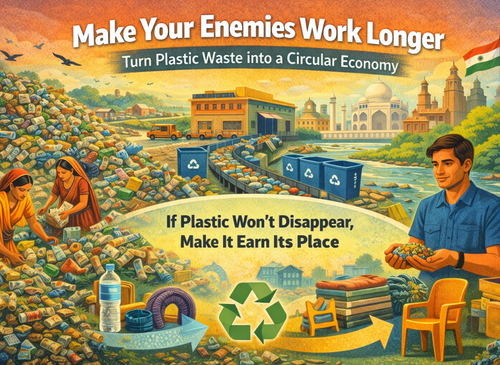
Traditionally, plastic follows a straight line: make → use → dump. This “take–make–dispose” model drains resources and damages the planet. Recycling breaks that pattern and replaces it with a circular economy.

In this loop, plastic never retires early.
Bottles turn into fabric.
Packaging becomes building material.
Old containers become furniture or roads.

By extending plastic’s life, we cut the need for virgin plastic. That matters because most plastic comes from fossil fuels like petroleum and natural gas. Recycling reduces fresh extraction, saves energy, and lowers carbon emissions.

Less waste.
Less pollution.
Lower climate impact.

And there’s another upside we don’t talk about enough—jobs.

Plastic recycling creates work across the chain: collection, sorting, processing, transport, and manufacturing. It supports waste pickers, recycling units, logistics workers, and small manufacturers. When done right, it formalises informal labour and drives inclusive economic growth.

So no, recycling isn’t a soft solution.
It’s a smart one.

If plastic won’t disappear, make it earn its place.
Make your enemies work longer.

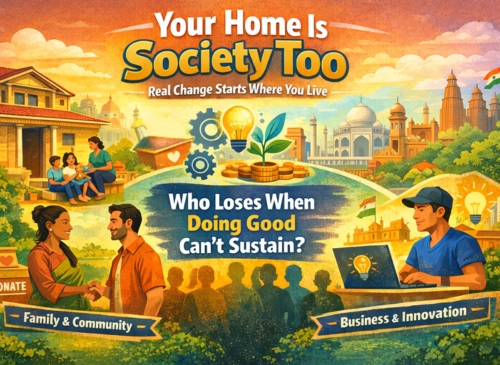
Your Home Is Society Too

Social impact doesn’t start in offices or NGOs.
It starts at home.

Just like every drop makes an ocean, every individual and every family builds society. Real change happens only when everyone plays a part.

For a long time, we’ve believed that only governments or non-profits can serve society. That idea is outdated.

When we talk about social responsibility, we often picture full-time social workers sacrificing everything. What we forget is this: social workers are part of families too. Their homes are not outside society. They are society’s smallest, strongest units.

When a social worker builds a stable home, cares for their family, and lives by strong values, they strengthen society at its roots. But stability needs support. Purpose needs income. Impact needs sustainability.

Doing good should not mean living insecure.
Charity should never demand self-neglect. Balance matters.

The same applies to businesses.

Profit is often judged as greed. That’s a lazy take. Profit is not exploitation. Profit means sustainability. A profitable business creates jobs, pays taxes, fuels local economies, and invests in innovation. That is social impact in action.

If we push profit-driven organisations out of social work, we risk losing talent, energy, and long-term solutions. Fewer people will choose social impact as a career. And the system will weaken.

So ask yourself:
If those who do good can’t sustain themselves—who really loses?